
György Kurtág
Kafka Fragments
Anu Komsi – soprano
Sakari Oramo – violin
Introduced from the stage by Alex Humphreys
Reviewed by: Nick Breckenfield
Reviewed: 9 August, 2026
Venue: Bristol Beacon, Lantern Hall
My third and final concert as part of the Bristol Proms weekend was in Bristol Beacon’s Lantern Hall, the chamber venue adjacent to the main hall. One work and just two performers, so, in fact, the only chamber Prom I will get to this season.
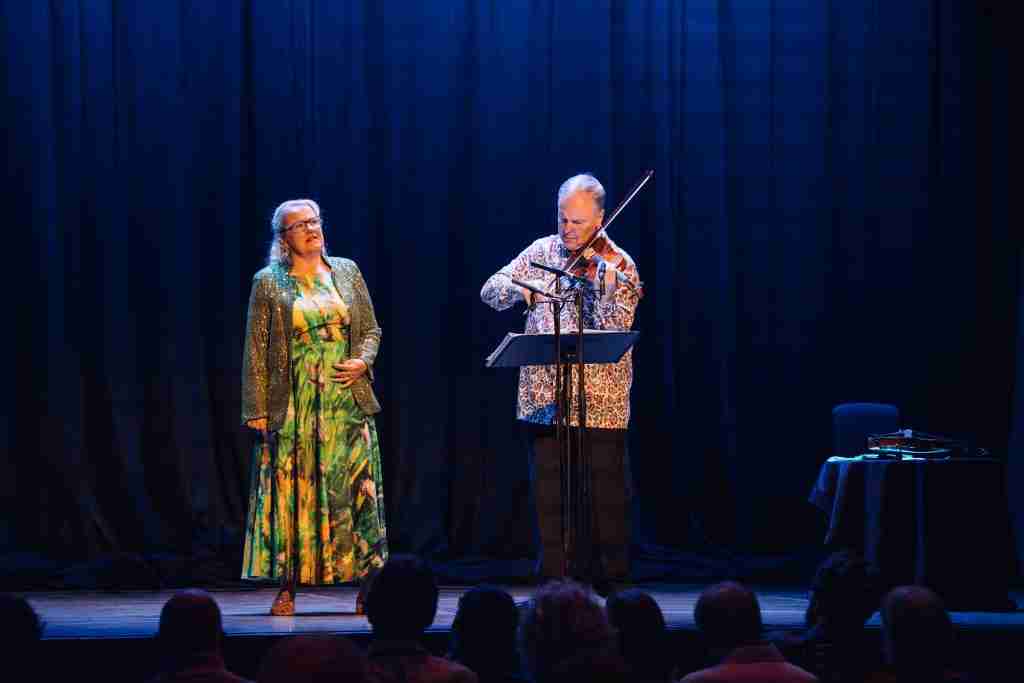
Introduced from the stage by Alex Humphreys, this performance of centenarian György Kurtág’s Kafka Fragments was very much a family affair. As soprano Anu Komsi, resplendent in floral dress and gold jacket, told Humphreys, she and Sakari Oramo (in blue and white patterned shirt) learnt the first part while studying, and courting, 38 years ago. That was only a couple of years after it was written and, in 1996 – Kurtág’s 70th birthday year – they released a recording of the complete work on the Ondine label. Thirty years on, it is still in their repertoire with the benefit of Kurtág having heard them perform it, and here it formed the second and final nod to his 100th birthday, following Oramo’s conducting of Stele at the Royal Albert Hall a couple of weeks ago.
As a complete contrast to Stele – with its massive orchestra – Kafka Fragments takes 40 intimate snippets from Kafka’s diaries, and scores them for just a violin accompaniment to the solo soprano line. Together they make up one of his longest works, nearly an hour, and collectively portray a slightly tortured insight into a world on the brink of collapse. The text is in German (and for this concert text and translation were available and handed out on entering the hall) and no individual quote was more than a few lines, and one (the fourth ‘song’) is just one word: Restless.
By turns spirited, contemplative, vehement, poignant and above all intimate, Kurtág finds humour in the interplay between voice and violin – for a couple Oramo swapped violins, the first time so he could change the pitch by turning a string’s peg. Sometimes contrasting moods and at other times they ‘sang’ from the same hymn sheet. The final of four parts (the second part having included just one Kafka quote) ends with violin alone. Interconnections include reprises of certain sections in Parts 1 and 3, notably a Lullaby with the somewhat incongruous statement ‘Slept, woke, slept, woke, miserable life…’ appearing three times.
Both vocal and violin lines are in distinctly modernist styles, as modern now as in 1986. But, as ever, Kurtág, (as are Komsi and Oramo) is a persuasive advocate for his own sound world, and the hour, in its splintered microcosms, successfully transported the enthusiastic audience to another place before returning us – perhaps slightly shell-shocked – to the still sunny Bristol early evening.