
Vítězslava Kaprálová
Military Sinfonietta, Op. 11 (Proms premiere)
Antonín Dvořák
Piano Concerto in G minor, Op. 33 (ed. Vilem Kurz)
Leos Janáček
Glagolitic Mass
Mao Fujita
piano
Corinne Winters
soprano
Bella Adamova
mezzo-soprano
David Butt Philip
tenor
Brindley Sherratt
bass
Christian Schmitt
organ
The City of Prague Philharmonic Choir
Czech Philharmonic
Jakub Hrůša
conductor
Reviewed by: Peter Reed
Reviewed: 28 August, 2024
Venue: Royal Albert Hall
The curtain-raiser to the second of the Czech Philharmonic’s two Proms was the Military Sinfonietta by Vitězslava Kaprálová (1915-40), who in her short life was one of the high hopes of Czech music. She lived at the time of the rise of Hitler but moved to Paris to study with Bohuslav Martinů in 1938. They had a passionate affair, but in 1940, the year of her death (possibly from typhoid, aged 25), she married Jiří Mucha, the son of the Czech artist Alphonse Mucha, who later (in 1942) married the Scottish composer Geraldine Thomson (1917-2012). The Sinfonietta is no masterpiece, but it overflows with energy, patriotism and romance, and Kaprálová probably over-indulges the brass section, all of which was honoured by the Czech Philharmonic’s performance – Kaprálová conducted the same orchestra at the work’s premiere in Prague in 1937, the first woman to do so. One can only speculate on this gifted composer’s potential.
Dvořák composed three concertos (four if you include the early, unfinished one for cello). The Piano Concerto (1876) was the first, and it has been on the receiving end of Brucknerian levels of improvement and editing, both from the composer and pianists. Yet, despite its many attractions, it stays in the repertoire shadows and has never cornered the play on emotions in the same way as, say, the Cello Concerto. It had, however, the most persuasive performance. To watch Hrůša at work is to witness a masterclass in engagement and support – something singers will have much to be grateful for when he takes over at the Royal Opera House next year – and his players, steeped in the Dvořák idiom, responded in effortless, characterful style.
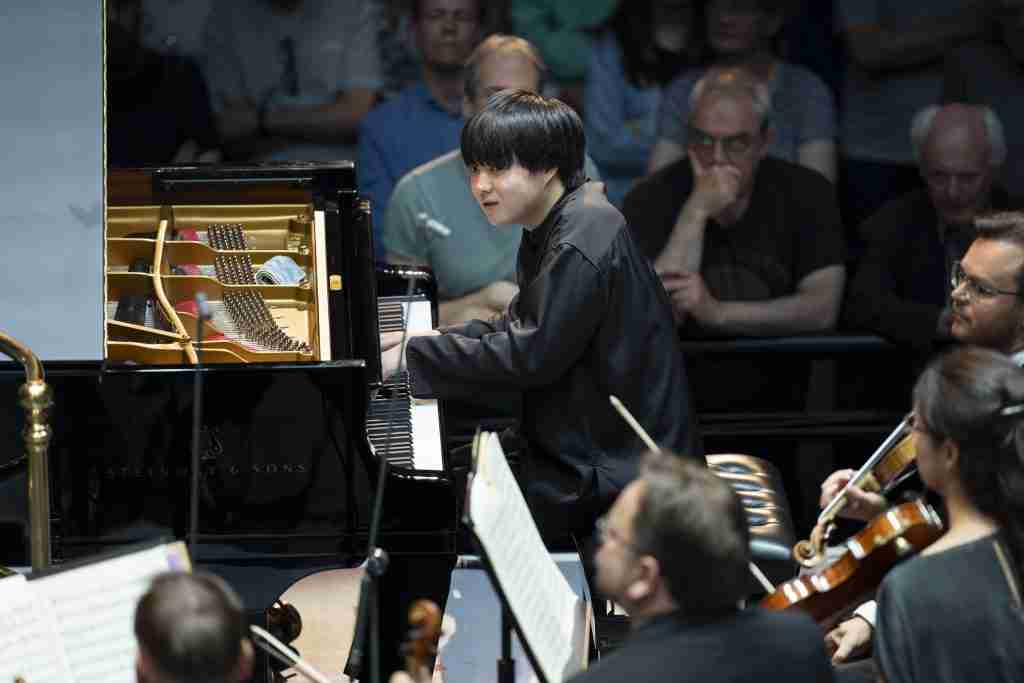
Making his Proms debut, the soloist was the young Japanese pianist, Mao Fujita. Anyone who heard some or all of his Mozart Sonata series last year will have been impressed not just by his guileless vitality and freshness but also by his imaginative way into music that clearly means a lot to him. And he is no stranger to the heavier, war-horse repertoire. All of which suited the Dvořák Concerto well, in a performance that camouflaged the fact that its length could also do with editing. Fujita was marvellous in giving the piano role a high level of star quality and independence from the orchestra, particularly in the rhapsodic flow of the prodigally tuneful first movement. The Nocturne-like Andante referenced a Chopinesque delicacy, with Fujita elegantly accompanying ravishing string and horn playing, then letting rip in the Rondo finale, a brilliantly rhythmic Furiant dance. Despite enthusiastic applause, Fujita declined giving an encore, having distinguished himself in a Piano Concerto that has been described as written for two left hands.
Then came an unforgettable performance of Janáček’s Glagolitic Mass, not only with a Czech orchestra and conductor but also a Czech chorus who delivered the Old Church Slavonic translation of the Mass in some style, not surprisingly. Janáček was agnostic – or so he said – but his setting observes all the crucial moments of the Latin rite – the ecstatic finale to the Gloria, the mystery of the ‘Et incarnatus’ in the Creed, the word ‘Veruju’ (I believe) stealing in with hushed amazement, then the reverence of the Benedictus section of the Sanctus – all delivered with a stirring vigour and conviction.
It was no stretch to imagine that the Mass was written for and being performed by the vivid parade of characters – from a cunning little vixen to terrifying kostelnička – that comes to life in Janáček’s operas so forcefully. As the celebrant of the Mass, the tenor David Butt Philip nailed his entrances in the Creed with a volume that rang round the Albert Hall. Corinne Winters and Bella Adamova sang like angels avenging and consoling, with the bass Pavel Šwringr (replacing Brindley Sherratt without any announcement) delivering his small solo role with authority. Hrůša balanced style, drama, and control to produce an inimitable, grand and mysterious sound from chorus and orchestra, and the atmosphere was electric. The German organist Christian Schmitt then delivered a stupendous and mad organ solo which gave the mighty Henry Willis instrument an equally mighty workout, and in the brief orchestral finale joy was unconfined. You had to ask where music like this comes from.