
Copland
Billy the Kid Suite
Gabriel Kahane
Clarinet Concerto in D major, “If Love will not swing wide the gates”, BBC co- commission: European Premiere
Stravinsky
Petrushka (1947 version)
Anthony McGill (Clarinet)
BBC National Orchestra of Wales
Ryan Bancroft
Reviewed by: Brian Barford
Reviewed: 17 August, 2026
Venue: Royal Albert Hall, London
Two classic twentieth century ballet scores bookended a new American clarinet concerto receiving its European premiere for an unconventional but attractive Prom which drew a good house at the Royal Albert Hall. It was also the last concert for Ryan Bancroft in his five-year tenure as Chief Conductor of the BBC National Orchestra of Wales. Bancroft is a reassuring presence on the podium and there have been some notable BBCNOW performances under his baton at the Proms such as a fervent Verdi Requiem from two years ago.
Aaron Copland’s Billy the Kid suite opened the programme in its seven – movement suite form – only two movements less than the complete score. The original ballet was choreographed by Eugene Loring for the Ballet Caravan Company in 1938 and is a significant work in the history of American ballet. More recently, it has been incorporated into Justin Peck’s 2023 full length ballet Copland Dance Episodes for the New York City Ballet.
It is ripe Copland Americana but with an undertow of melancholy and Bancroft seemed keen to emphasise this throughout, rather than brashness. It wasn’t an especially balletic or dramatic reading but was strong on affection and nostalgia. The first movement The Open Prairie had less a sense of wonder at the vast expanse of open prairie stretching out before us than a feeling of tenderness and warmth. Bancroft kicked off Street Scene in a Frontier Town by playing his own piccolo solo from the podium and there were snappy rhythms throughout. The Card Game at Night had an affecting trumpet solo and the Gun Battle was suitably percussive – the strange nightmarish polka for the Celebration after Billy’s Capture section was well delineated. The closing Open Prairie Again represented a return to poignancy that slowly gave way to a characteristic Copland broadening out that was delivered in resounding style.
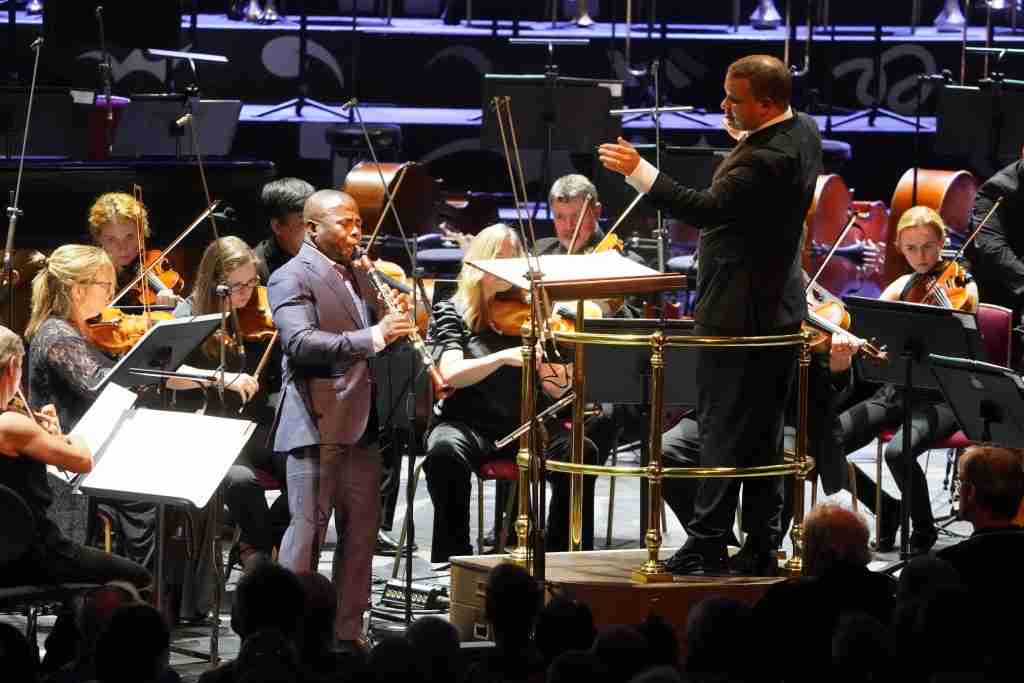
Gabriel Kahane’s Clarinet Concerto was composed for the New York Philharmonic’s Principal Clarinet Anthony McGill who gave its world premiere with the Orlando Philharmonic in 2025. Kahane is the son of the pianist and conductor Jeffrey Kahane and is a singer-songwriter whose work is similar in style to Sufjan Stevens and Rufus Wainwright, both of whom he has collaborated with several times. The concerto’s subtitle “If Love will not swing wide the gates” is a quote from James Baldwin writing in The Fire Next Time and speaks of the need for human love to survive in a world that makes no space for the individual. Kahane’s initial intention was to explore the complex historical relationship between black and Jewish communities in the 20th century but he abandoned this extramusical concept, perhaps wisely, as he found it difficult to define a single community, let alone the dynamic between the two, and concentrated on the sound of the clarinet. It is in three continuous movements with an atmospheric intermezzo and a virtuosic coda, and is scored for small string section, percussion and piano. At times I was reminded of Copland’s Quiet City with its shared nocturnal quality. Anthony McGill was the perfect soloist with his warm tone and fluid phrasing. The percussion was busy but not overly – assertive and at one point two percussionists walked through the orchestra to stand behind the soloist and clap rhythmically. From the languid introduction through to wistful interludes, McGill gave a song-like quality to the solos. It is an undemanding piece that is full of attractions and often seems close to jazz. Whilst it lasts only 22 minutes there was the nagging feeling that it was ever so slightly too long. Kahane came on stage at the end to acknowledge the applause and gave, as an encore with McGill, a version of one of his most famous songs A Little Love, which just skirted sentimentality.
Stravinsky’s Petrushka was given in its 1947 version with reduced woodwind and brass and enhanced piano. As a ballet Petrushka, with its problematic depiction of The Moor, is a difficult watch for modern audiences and it hasn’t been seen on stage in London since the Royal Ballet’s production in 1995. It is a different story in the concert hall, and the 1947 version was receiving its 31st performance at the Proms, where the full 1911 version has had only 19 outings. Performances by Charles Mackerras and Pierre Boulez live in the memory. Ryan Bancroft’s performance wasn’t especially high-voltage but was attuned to Stravinsky’s intricate sound world. Some details came through with phrasing or adjusted sound levels that felt fresh and newly-minted such as the gorgeous flute passage in the first tableau (Matthew Featherstone, I believe) or the brutal ejection of Petruska in the third tableau. The teeming final tableau was buoyant and had mounting tension leading to Petrushka’s death whilst the apparition of Petrushka’s ghost worked its spell. There were some imprecisions, especially in the brass, but Bancroft drew playing of detail and character from the orchestra throughout. Stravinsky openly identifies the puppet with the piano and Catherine Roe Williams was the hard-working pianist, as she had been in all three pieces.