
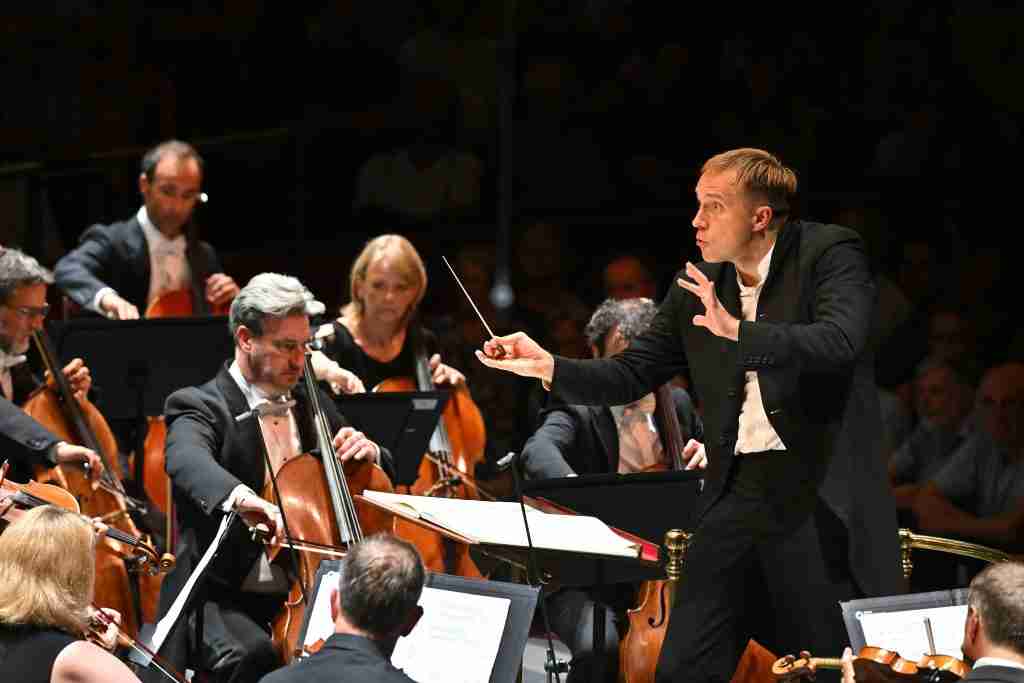
Webern
Passacaglia for orchestra, Op. 1
Elgar
Cello Concerto in E minor, Op. 85
Walton
Symphony No. 2
Pablo Ferrández (cello)
Royal Philharmonic Orchestra
Vasily Petrenko
Reviewed by: David Gutman
Reviewed: 16 August, 2026
Venue: Royal Albert Hall, London
In the wake of gargantuan Berlioz, the stage was reset for a less sensational event: a concise, surprisingly well attended concert from an orchestra unmistakably on the rise. A similar upward trajectory applies to William Walton, whose later oeuvre is finally attracting renewed attention. Following the critical and box-office failure of his 1954 opera Troilus and Cressida—a period that coincided with the ascendancy of his ‘rival’ Benjamin Britten—the older composer rebounded with a series of highly polished scores. Unfortunately, with the partial exception of the Cello Concerto (itself featured earlier this season), these made little impact, George Szell being virtually alone among top-tier conductors in championing them.
Walton himself directed his First Symphony at five Proms between 1936 and 1959. After a hiatus during the William Glock era, performances have resumed at a rate of roughly three per decade. Compare that to the stark fate of its successor, which had accumulated a mere four renditions prior to tonight’s. Walton’s Second Symphony did feature elsewhere during Vladimir Ashkenazy’s RPO tenure—the team took it to Moscow in 1989—but so far as I am aware this performance marked Vasily Petrenko’s first stab at the piece. In recent years he has done more than join those non-native-born conductors who schedule Walton’s celebrated pre-War masterpieces; he has also championed later rarities like the Johannesburg Festival Overture (a particular bête noire of Glock’s) and the Partita for Orchestra. The Second Symphony is a less insouciant work than either yet one that remains markedly Gallic in its demand for absolute clarity of sound—a prerequisite previous Proms performances have largely failed to satisfy. In terms of scoring at least, it represents a distinct evolutionary step forward.
Walton rarely composed more than one major concert work in any given genre, making his two symphonies an intriguing anomaly. The BBC’s website promised us a work ‘rejecting the avant-garde in favour of a dense, Expressionistic intensity’. I’m not sure that makes much sense. While the third movement, a species of passacaglia, opens with a massive unison statement of a theme composed of all twelve notes of the chromatic scale, the Symphony is usually regarded as the more circumspect of his two pieces in that form. The concert had begun with another take on the passacaglia, Webern’s Op.1, in which the future serialist is still in Brahmsian mode and the main idea, a pizzicato ground bass, had to compete with the hum of the air cooling and the rustle of unwrapping foodstuffs. Many accounts tend either to revel in late-Romantic lushness or incline towards future hairshirt modernism. Petrenko went his own vaguely Russifying way, imparting unorthodox colour and near-hysterical drive.
To complete the first half, conductor and orchestra were reunited with Pablo Ferrández. I remember writing up the same artists’ Shostakovich First Cello Concerto as something of a misfire a few years back although its slow movement was special. Elgar’s autumnal mood certainly suited better. For those in thrall to the recently fashionable ‘restraint’ exemplified by Alban Gerhardt in his new Hyperion recording, Ferrández may have felt too close to the ‘gush’ of Jacqueline du Pré. While tempos were by no means uniformly slow, Ferrández made a meal of introductions and transitions in a way that could be construed as more laboured than illuminating. That said, his tone quality had none of the heaviness and grit some impose on this delicate music, the sheer precision of his playing was breathtaking in the second movement (shame about the intrusive applause) and he had no qualms about addressing the Promenaders directly in the third and fourth, his pianissimo retreating below the threshold of audibility for those of us in more distant seats. That he could get away with the lyricism and the leanness had a great deal to do with the consummate contribution of conductor and orchestra. Their ‘accompaniment’ was so much more, the Concerto rethought as a conversation of subtlety and quiet iridescence. A real revelation or so it seemed in the hall. An eloquent encore, Pablo Casals’s Song of the Birds was pre-ordained, lighting adjusted accordingly.
After the interval the Walton blazed as one hoped it might. Rhythms were nailed with confidence even if, as with some of John Wilson’s Walton interpretations, the rigour came at the expense of a certain whimsicality and bounce, jazzier elements undersold. The most controversial element of the reading was Petrenko’s decision to radically relax the tempo a minute in. This slower tempo, unmarked though carrying on logically enough in the vein of Walton’s espressivo cello bridge, returned later. One wondered what the players thought of this. Elsewhere for good or ill, anxious urgency sometimes ran counter to the free-spirited atmosphere promised in the programme note. The remaining movements worked perfectly, and the closing ovation was enthusiastic, confirming the orchestra’s status without knocking Szell off his perch.